Open-source multi-omics

Unified multi-omics in Python. Rust and Torch underneath.

Bulk, single-cell, spatial, and multi-modal — all AnnData-native. Hot loops in Rust; tensor methods on Torch.

$pip install omicverse

Featured projects

The core stack.

All packages

Ecosystem coverage

Omics modules already covered by OmicVerse.

One ecosystem spans raw assays, preprocessing, major omics modalities, and domain-specific analysis layers.

DNA Assay FASTA, count matrix, VCF, and alignment-oriented input layers. ov.align
QC Preprocess QC, normalization, PCA, clustering, and batch correction. ov.pp
SC Single-cell Velocity, annotation, NMF, trajectory inference, and cell-state analysis. ov.single
XY Spatial Spatial clustering, deconvolution, neighborhoods, and segmentation workflows. ov.space
BK Bulk Bulk transcriptomics, differential analysis, deconvolution, and pathway context. ov.bulk
FM Foundation Cell embeddings, perturbation models, and foundation-model workflows. ov.fm
3D Molecular Molecular structure, docking, and structure-aware analysis. ov.mol
AT Epigenomics ATAC, ChIP, Hi-C, CUT&Tag, CUT&RUN, and regulatory signals. ov.epi
MB Microbiome 16S workflows, taxonomy summaries, diversity analysis, and abundance testing. ov.micro
MT Metabolomics ID mapping, MSEA, Mummichog, SERRF, biomarkers, and pathway-level readouts. ov.metabol

How it fits together

One Python surface. Rust and Torch in the engine room.

The unified library sits on top of language-appropriate compute backends, with everything speaking AnnData.

/01 One API across data types The same ov.pp / ov.tl / ov.pl surface works for bulk, single-cell, spatial, and multi-modal data — read it once, use it everywhere.
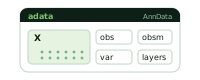
/02 AnnData throughout Inputs and outputs match the scanpy / AnnData conventions, so OmicVerse plugs into pipelines you already have without rewrites.
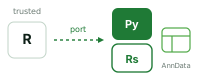
/03 Rust for hot loops Compute-heavy paths (NMF, Hi-C imputation, BandNorm normalization) are written in Rust — 10–200× speedups with bit-identical numerics.
/04 Torch for tensor methods Tensor and deep-learning methods run on PyTorch with first-class GPU support; classical methods stay on NumPy / SciPy.

From the blog

Recent notes.

All posts